
QUALITY ANALYSIS OF CHARCOAL BRIQUETTES PRODUCED FROM MERANTI AND ULIN WOOD SAWDUSTAS AN ALTERNATIVE FUEL
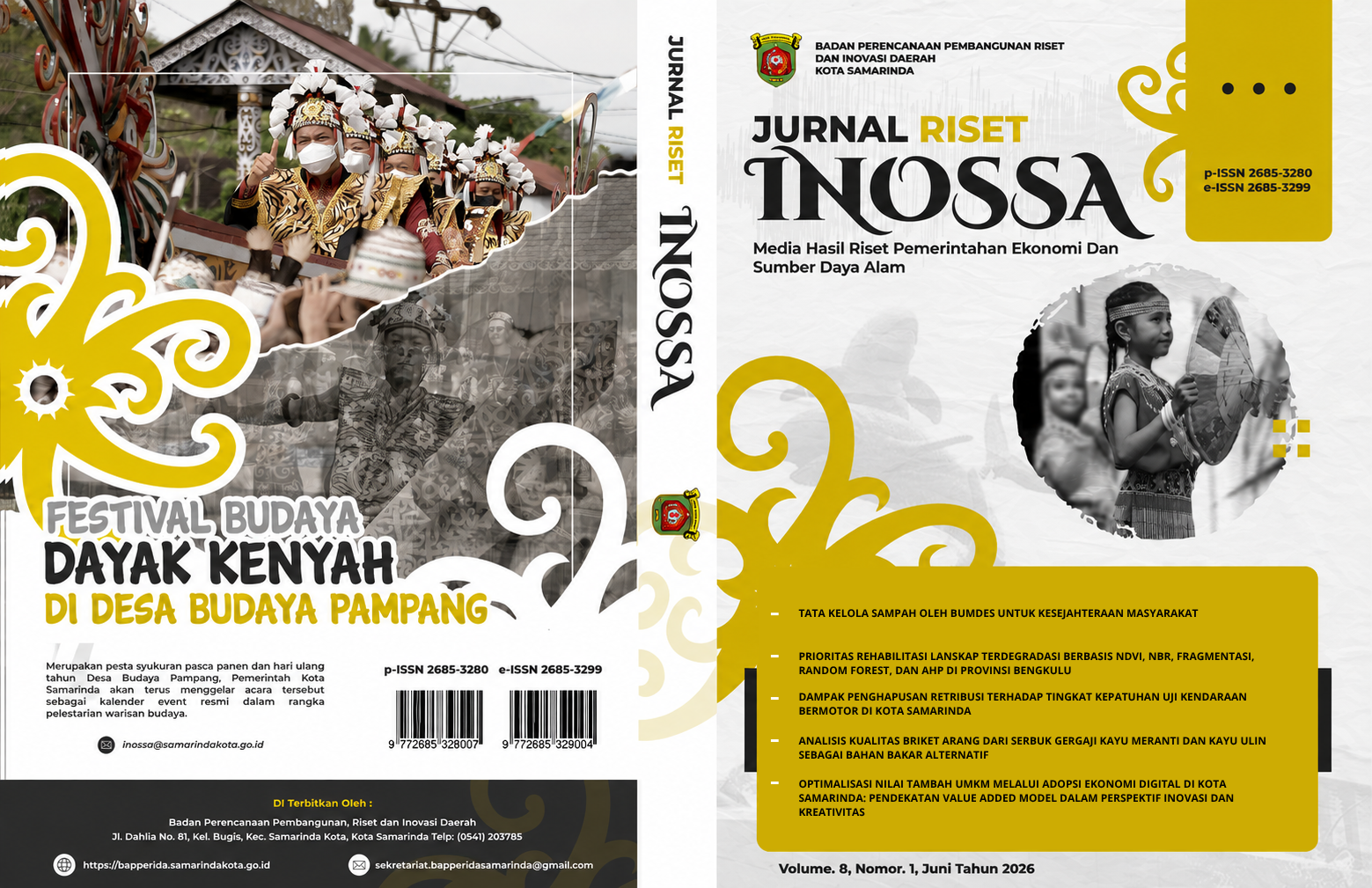
ANALISIS KUALITAS BRIKET ARANG DARI SERBUK GERGAJI KAYU MERANTI DAN KAYU ULIN SEBAGAI BAHAN BAKAR ALTERNATIF
DOI:
https://doi.org/10.54902/83mzrd15Keywords:
sawdust, meranti, ulin, charcoal briquetteAbstract
The presence of biomass waste from Meranti and Ulin sawmill industries has the potential to pollute the environment while simultaneously storing renewable energy that remains underutilized. This study aims to analyze the quality of charcoal briquettes made from a mixture of Meranti and Ulin sawdust at various compositions, referring to the SNI 01-6235-2000 standard. The tested briquette quality parameters include moisture content, volatile matter, ash content, and calorific value. Meanwhile, density is not included as a testing parameter under the SNI standard; thus, its quality evaluation refers to the FAO standard.
The results showed that the briquette density ranged from 0.3671 to 0.6438 g/cm³, with the treatment of 25% Meranti + 75% Ulin composition meeting the FAO standard (0.40–0.70 g/cm³). The moisture content ranged between 4.8674% and 7.1813%, all of which fell below the maximum SNI threshold (< 8%). The ash content fell within the range of 3.5454% to 6.3255%, also satisfying the SNI standard. The calorific value ranged from 5,576.40 to 6,020.73 cal/g, confirming that all treatments met the minimum calorific value requirement according to SNI (> 5,000 cal/g).
However, the volatile matter parameter exhibited relatively high values, ranging from 36.1327% to 48.9953%. This high volatile matter content indicates an sub-optimal carbonization process and a remaining high concentration of volatile compounds within the raw materials. Overall, four out of the five quality parameters successfully met the SNI and FAO standard, demonstrating that the mixture of Meranti and Ulin holds significant potential as a raw material for quality briquettes, though improvements in the carbonization process are required to reduce the volatile matter content.
Downloads
References
Alpian, A., Sinaga, J. P., Joni, H., Yanciluk, Y., Supriyati, W., Nuwa, N., Luhan, G., & Wanasetya, A. (2024). Karakteristik Briket Arang Dari Limbah Serbuk Meranti (Shorea Spp). Jurnal Hutan Tropis, 12(1), 1. https://doi.org/10.20527/jht.v12i1.19003
As siddiqi, M. J., Syafitri, A. E., Kurniawan, S., & Farahdiansari, A. P. (2024). Pembuatan Biobriket dari Limbah Kayu UMKM Sebagai Energi Alternatif Rumah Tangga di Desa Bancer. Abdimas Universal, 7(1), 97–103. https://doi.org/10.36277/abdimasuniversal.v7i1.545
Imam Ardiansyah, Yandra Putra, A., & Sari, Y. (2022). Analisis Nilai Kalor Berbagai Jenis Briket Biomassa Secara Kalorimeter. Journal of Research and Education Chemistry, 4(2), 120. https://doi.org/10.25299/jrec.2022.vol4(2).10735
Iskandar, N., Nugroho, S., Meta, D., Feliyana, F., & Sudharto, J. (2019). Uji Kualitas Produk Briket Arang Tempurung Kelapa Berdasarkan Standar Mutu SNI. Momentum, 15(2), 103–108.
Iswara, M. A. I., Mustain, A., Mufid, M., & Prayitno, P. (2024). Studi Literatur Karakteristik Briket Dengan Perbedaan Rasio Campuran Arang Tempurung Kelapa Dan Biomassa Lainnya. DISTILAT: Jurnal Teknologi Separasi, 10(1), 56–69. https://doi.org/10.33795/distilat.v10i1.4466
Maharani, F., Kurniawan, E., & Ginting, Z. (2022). Pembuatan Briket Dari Arang Serbuk Gergaji Kayu Dengan Perekat Tepung Singkong Sebagai Bahan Bakar Alternatif. In Jurnal Teknologi Kimia Unimal (Vol. 11, Number 2).
Palamba, P. (2026). Pemanfaatan limbah serbuk gergajian kayu merbau (<i>intsia spp.</i>) sebagai briket biomassa untuk energi rumah tangga. Proceeding SNTTM BKS-TM Indonesia, 23(1), 142–148. https://doi.org/10.71452/js983b80
Pamungkas, A. W., Ayu Yusuf, M., & Teraka, M. (2026). Wood Waste Charcoal Briquettes: Physical and Thermal Characteristics Based on Particle Size and Wood Type. Jurnal Keteknikan Pertanian, 13(4), 613–626. https://doi.org/10.19028/jtep.013.4.613-626
Putra, B. S., & Hidayat, A. A. (2022). Briket Dari Cangkang Kelapa Sawit Menggunakan Perekat Daun Belimbing Wuluh. Jurnal Teknik Terapan, 1(1), 14–19. https://doi.org/10.25047/jteta.v1i1.7
Rachma, E. A., Eryadini, N., Nurdiana, R., Machsunah, Y. C., & Sutarum. (2024). Pelatihan Pembuatan Briket dari Limbah Gergaji Kayu untuk Meningkatkan Keterampilan Kewirausahaan. 5(2), 24–31. https://doi.org/10.36456/ekobisabdimas.5.2.9980
Retnawati, E., Apriani, I., & Sulastri, A. (2023). Pemanfaatan Sampah Organik dan Serbuk Kayu Menjadi Biobriket sebagai Energi Alternatif. Dampak, 20(1), 43–48. https://doi.org/10.25077/dampak.20.1.43-48.2023
Rozidi, S., Diah Ajeng Setiawati, M., & Fuadi. (2024). Analisis Kualitas Briket Serbuk Gergaji Dengan Perekat Tepung Pati Bonggol Pisang (Musa paradisiaca L.). J-AGENT, 2(1). https://journal.unram.ac.id/index.php/agent/article/view/3098
Sari, P. N., & Aminah, S. (2020). Pemanfaatan Serbuk Gergaji Sebagai Bahan Baku Briket. Media Eksakta, 16(2), 98–104. https://doi.org/10.22487/me.v16i2.740
SNI 01-6235-2000. (n.d.). Standar Nasional Indonesia Briket arang kayu.
Suhartana, S., Yuniawati, Gandaseca, S., Dulsalam, Soenarno, & Ratnasingam, J. (2022). Potential of Wood Harvesting Residues and Residual Stand Damage due to Timber Harvesting: A Case Study at PT Austral Byna in Central Kalimantan, Indonesia. International Journal of Forestry Research, 2022, 1–8. https://doi.org/10.1155/2022/3251945
The State of the World’s Forests 2020. (2020). FAO and UNEP. https://doi.org/10.4060/ca8642en
Tomen, W. T., Nna, T. P. N., Sapnken, F. E., Diboma, B. S., Abdelkerim, A. A., Marcelin, M. P., & Tamba, J. G. (2026). Energetic, economic and social analysis of briquettes made from sawdust of two tropical wood species and their hybrids: Milicia excelsa (Iroko) and Pterocarpus soyauxii (Padouk). Energy Reports, 15, 109014. https://doi.org/10.1016/j.egyr.2025.109014
Triadi, A. A. A., Mulyanto, A. A., Joniarta, I. W., Wijana, M., & Nuarsa, I. M. (2022). Penerapan Teknologi Briket pada Pengusaha Arang Tempurung Kelapa Tradisional. JURNAL KARYA PENGABDIAN, 4(1), 53–58. https://doi.org/10.29303/jkp.v4i1.121
Wahyudi, W., & Tanggasari, D. (2023). Uji karakteristik briket serbuk gergaji kayu jati dengan pencampuran ampas tebu berdasarkan jumlah variasi perekat (tepung beras ketan). Sultra Journal of Mechanical Engineering (SJME), 2(1), 17–28. https://doi.org/10.54297/sjme.v2i1.426
Wahyuningtyas, I., Wartomo, Ibo, A., & Syafi’i. (2026). Pengaruh Formulasi Serbuk Kayu dan Perekat terhadap Karakteristik Dasar Briket Arang Kayu Ulin. Wahana Forestra: Jurnal Kehutanan, 21(1), 47–60. https://doi.org/10.31849/awy50p10
Wulandari, F. K., Wardana, R. W., Setiawan, I., Koto, I., & Parlindungan, D. (2025). Kualitas Briket Arang Berbahan Baku Cangkang Kemiri (Aleurites mollucanus) dan Serbuk Kayu Jati (Tectona grandis). ULIN: Jurnal Hutan Tropis, 9(2), 309. https://doi.org/10.32522/ujht.v9i2.19630
Yulia, A., Yernisa, Y., & Fiardilla, F. (2026). Characteristics Of Biobriquette From Areca Nut Waste And Coconut Waste With Various Types And Proportion Of Binders. Jurnal Ilmiah Ilmu Terapan Universitas Jambi, 10(1), 201–220. https://doi.org/10.22437/jiituj.v10i1.48001
Yuni, M. R., Faisal, Nurlaila, R., Ulfa, R., & Fibarzi, W. ulfa. (2025). Pembuatan Briket dari Tempurung Kelapa dan Serbuk Gergaji Kayu dengan Perekat Tepung Tapioka sebagai Bahan Bakar Alternatif. Chemical Engineering Journal Storage (CEJS), 5(05), 981–994. https://doi.org/10.29103/cejs.v5i05.23949
Downloads
Published
Issue
Section
License
Copyright (c) 2025 Heriad Daud Salusu, Ari Agusman, Riri Andriany, Andi Yusuf, Nur Maulida Sari, Eva Nurmarini

This work is licensed under a Creative Commons Attribution-NonCommercial 4.0 International License.