
LITERATURE STUDY OF THE CONTENT OF SECONDARY METABOLITES OF EAST BORNEO LEDANG PLANTS (ARTOCARPUS LANCEIFOLIUS) AS ANTICITOTOXIC
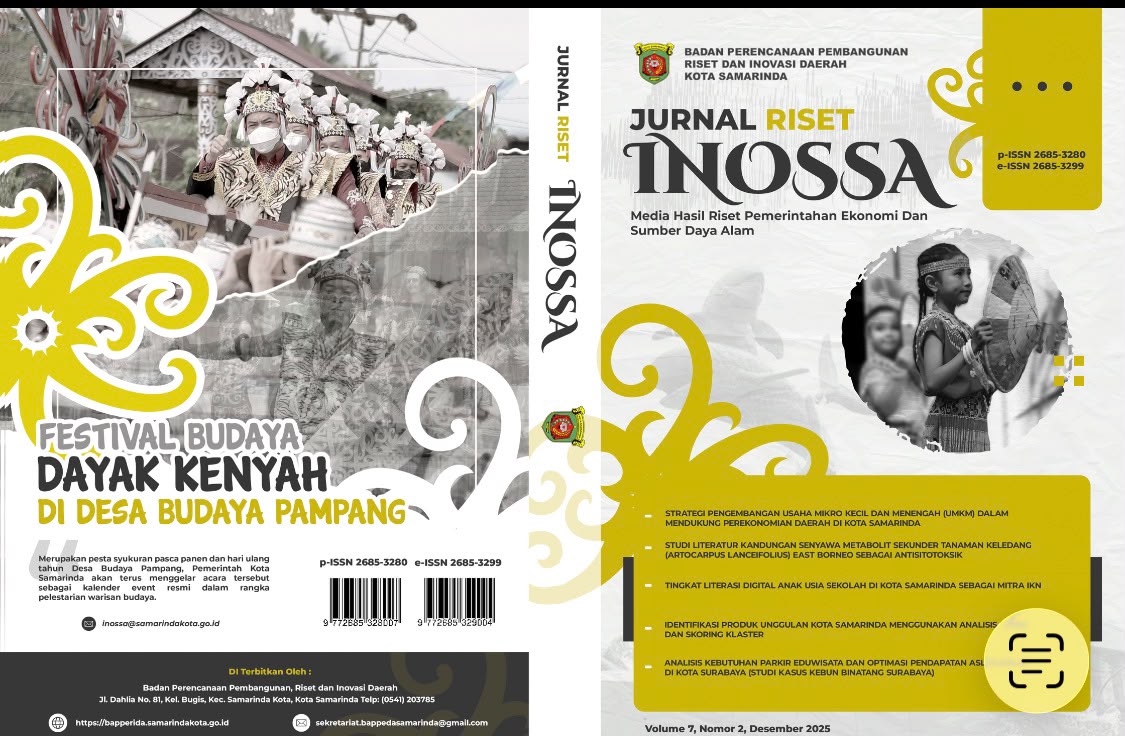
STUDI LITERATUR KANDUNGAN SENYAWA METABOLIT SEKUNDER TANAMAN KELEDANG (ARTOCARPUS LANCEIFOLIUS) EAST BORNEO SEBAGAI ANTISITOTOKSIK
DOI:
https://doi.org/10.54902/ktdqah74Keywords:
Anticytotoxic, Artocarpus lanceifolius, Cancer, Secondary metabolites, Keledang plant.Abstract
Cancer is characterized by the presence of abnormal cells that can grow uncontrollably and have the ability to invade organs, migrate to other tissues, and spread to distant sites. In Indonesia, cervical cancer is the second most common cancer after breast cancer, and it increases annually. The prevalence of cancer, according to a doctor's diagnosis, is 2.06 per thousand cases in urban areas and 1.47 per thousand in rural areas (Riskesdas, 2018). The keledang plant (Artocarpus lanceifolius), a typical fruit of Kalimantan, contains phenolic compounds and flavonoids, which are used as medicinal ingredients due to their cytotoxic properties. Several prenylated flavonoid compounds, including 23 types of artoindonesianin, have been successfully isolated (Bailly, 2021). The purpose of this literature study was to review the secondary metabolite compounds and the bioactivity of the keledang plant in inhibiting cancer cell growth. The method used in searching for review articles in national and international journals has been indexed by Scopus and accredited by SINTA using the PubMed, Google Scholar, and Research Gate platforms. A Systematic Literature Review (SLR) is an evidence-based review in identifying, assessing, and interpreting all research results. focused on a single research urgency. Research results showed that the keledang plant produces various isoprenylated flavonoid compounds containing an isoprenyl side chain at C-3, with a 2,4-dioxygenated or 2,4,5-trioxygenated pattern in the B ring of the 2,3-flavone skeleton, showing significant cytotoxic effects against murine leukemia P-388 cells (Musthapa, 2009). Artoindonesianin P and W, isolated from Artocarpus lanceifolius, were found to inhibit human neutrophil elastase (IC50 = 28.7 and 11.2 μM, respectively) (Ban et al., 2020). Artobiloxanthone actively binds the enzyme transglutaminase 2 (TG2), an enzyme that is an anticancer target (Akram, 2018).
Downloads
References
Akram Taleghani dan Zahra Tayarani-Najaran. (2018). Flavonoid Alami Sitotoksik yang Ampuh: Jurnal Batas Perspektif. Departemen Kimia, Fakultas Sains, Universitas Gonbad Kavous, PO Box 163, Iran.
Bailly, C. (2021). Anticancer mechanism of artonin E and related prenylated flavonoids from the medicinal plant Artocarpus elasticus. Asian Journal of Natural Product Biochemistry, 19(2).
Ban YJ, Baiseitova A, Nafiah MA, Kim JY, Park KH. 2020. Manusia dihydrobenzoxanthones penghambat neutrofil elastase dan flavon teralkilasi dari Artokarpus elastiskulit akar. Jurnal Aplikasi Biol Kimia 63: 63.
Hamsidar, H., Soekamto, N., M Syah, Y., & Firdaus, F. (2019). Determination of Secondary Metabolites, Toxicity and Antioxidant Activities of Bark Extracts of Artocarpus Lanceifolius Roxb. International research journal of pharmacy.
Haskas, Y., Permadani, T. Y. N., & Restika, I. (2021). Literature Review: Tanaman obat dengan multiple Effect Pada Penderita Diabetes Mellitus. (Jurnal Ilmiah Mahasiswa Kesehatan Masyarakat), 6(1).
Hidayah, N., Daniel, D., & Marliana, E. (2021). Aktivitas Ekstrak Metanol Daun Keledang (artocarpus lanceifolius roxb) Sebagai Antiinflamasi. IN PROSIDING SEMINAR KIMIA (pp. 126-131).
Kanthe, P. S., Patil, B. S., Das, K. K., & Parvatikar, P. P. (2021). Structural analysis and prediction of potent bioactive molecule for eNOS protein through molecular docking. In Silico Pharmacology, 9(1), 1-10.
Losuwannarak N, Sritularak B, Chanvorachote P. 2018. Cycloartobioxanthone Menginduksi Apoptosis Sel Kanker Paru Manusia melalui Jalur Apoptosis yang bergantung pada Mitokondria. Di Vivo 32: 71-78.
Isyahro, N. R., Widodo, N. T., & Marliana, E. (2021). Potensi Aktivitas Antioksidan Ekstrak Metanol Daun Keledang (Artocarpus lanceifolius Roxb). In PROSIDING SEMINAR NASIONAL KIMIA (pp. 121-125).
Minakawa T, Toume K, Arai MA, Koyano T, Kowithayakorn T, Ishibashi M. 2013. Prenilflavonoid diisolasi dariArtocarpus champedendengan aktivitas mengatasi resistensi TRAIL. Fitokimia 96: 299-304. Corrigendum dalam Fitokimia 2014, 106:207.
Musthapa I, Hakim EH, Juliawaty LD, Syah YM, Achmad SA. 2010. Flavon terprenilasi dari sebagian orang IndonesiaArtokarpusdan sifat antimalarianya. Pabrik Obat 2: 157-160
Naspiah, N., & Pratama, M. R. F. (2021). Xanthine Oxidase Inhibition Activity and ADMET Properties of Terap (Artocarpus odoratissimus Blanco) Leaves Metabolites: Phytochemical Screening and In Silico Studies. Pharmacognosy Journal, 13(5).
Nimnuan-ngam S, Yangnok K, Innajak S, Watanapokasin R. 2020. Efek artonin E pada induksi kematian sel apoptosis pada sel kanker usus besar. Jurnal Biomarker Epidemiol Kanker Sebelumnya 29, B061.
Parvatikar PP, Madagi SB. 2021. Analisis Docking Molekuler: Interaksi Studi Senyawa Alami dengan Protein TG2 Manusia. Dalam S-1.
Plaibua K, Pongrakhananon V, Chunhacha P, Sritularak B, Chanvorachote P. 2013. Pengaruh artonin E terhadap kemampuan migrasi dan invasi sel kanker paru-paru manusia. Jurnal Antikanker Res 33: 3079-3088.
Pratiwi, R., & Nurlaeni, Y. (2020). Screening of plant collection of Cibodas Botanic Gardens, Indonesia with anticancer properties. Biodiversitas Journal of Biological Diversity, 21(11).
Rahman MA, Ramli F, Karimian H, Dehghan F, Nordin N, Ali HM, Mohan S, Hashim NM. 2016. Artonin E Menginduksi Apoptosis melalui Disregulasi Mitokondria pada Sel Kanker Ovarium SKOV-3. Journal PLoS Satu 11: e0151466.
Riskesdas, K. (2018). Hasil Utama Riset Kesehata Dasar (RISKESDAS). Journal of Physics A: Mathematical and Theoretical, 44 (8), 1–200. https://doi.org/10.1088/1751-8113/44/8/085201.
Rivana, EJ (2020). Keanekaragaman Senyawa Flavonoid Yang Tercetak Dari Tanaman Pisang (Artocarpus lanceifolius roxb) dan Aktivitas Sitoksiknya Terhadap Sel Murine Leukemia P-388 (Disertasi Doktor, Universitas Pendidikan Indonesia).
Santos, C. M., & Silva, A. (2020). The antioxidant activity of prenylflavonoids. Molecules, 25(3), 696.
Seca, A. M., & Pinto, D. C. (2018). Plant secondary metabolites as anticancer agents: successes in clinical trials and therapeutic application. International journal of molecular sciences, 19(1), 263.
Setiawan, H., Khaerunnisa, R. N., Ariyanto, H., Fitriani, A., Firdaus, F. A., & Nugraha, D. (2021). Yoga Meningkatkan Kualitas Hidup Pada Pasien Kanker: Literature Review. Journal of Holistic Nursing Science, 8(1), 75-88.
Soekamto, N. H., & Syah, Y. M. (2019). Prenylated flavon and antibacterial activities of Artocarpus lanceifolius Roxb bark. In Journal of Physics: Conference Series (Vol. 1341, No. 7, p. 072014). IOP Publishing.
Sophonnithiprasert T, Mahabusarakam W, Watanapokasin R. 2019. Artonin E menyadarkan apoptosis yang diinduksi TRAIL dengan peningkatan regulasi DR5 dan downregulasi cFLIP pada sel LoVo kanker kolorektal tahan api TRAIL. J Saluran Pencernaan Oncol 10 : 209-217
Syah, Y. M., Achmad, S. A., Ghisalberti, E. L., Hakim, E. H., Makmur, L., & Mujahidin, D. (2001). Artoindonesianins GI, three new isoprenylated flavones from Artocarpus lanceifolius. Fitoterapia, 72(7), 765-773.
Taleghani, A., & Tayarani-Najaran, Z. (2018). Potent cytotoxic natural flavonoids: The limits of perspective. Current pharmaceutical design, 24(46), 5555-5579.
Downloads
Published
Issue
Section
License
Copyright (c) 2025 Roni setiawan

This work is licensed under a Creative Commons Attribution-NonCommercial 4.0 International License.